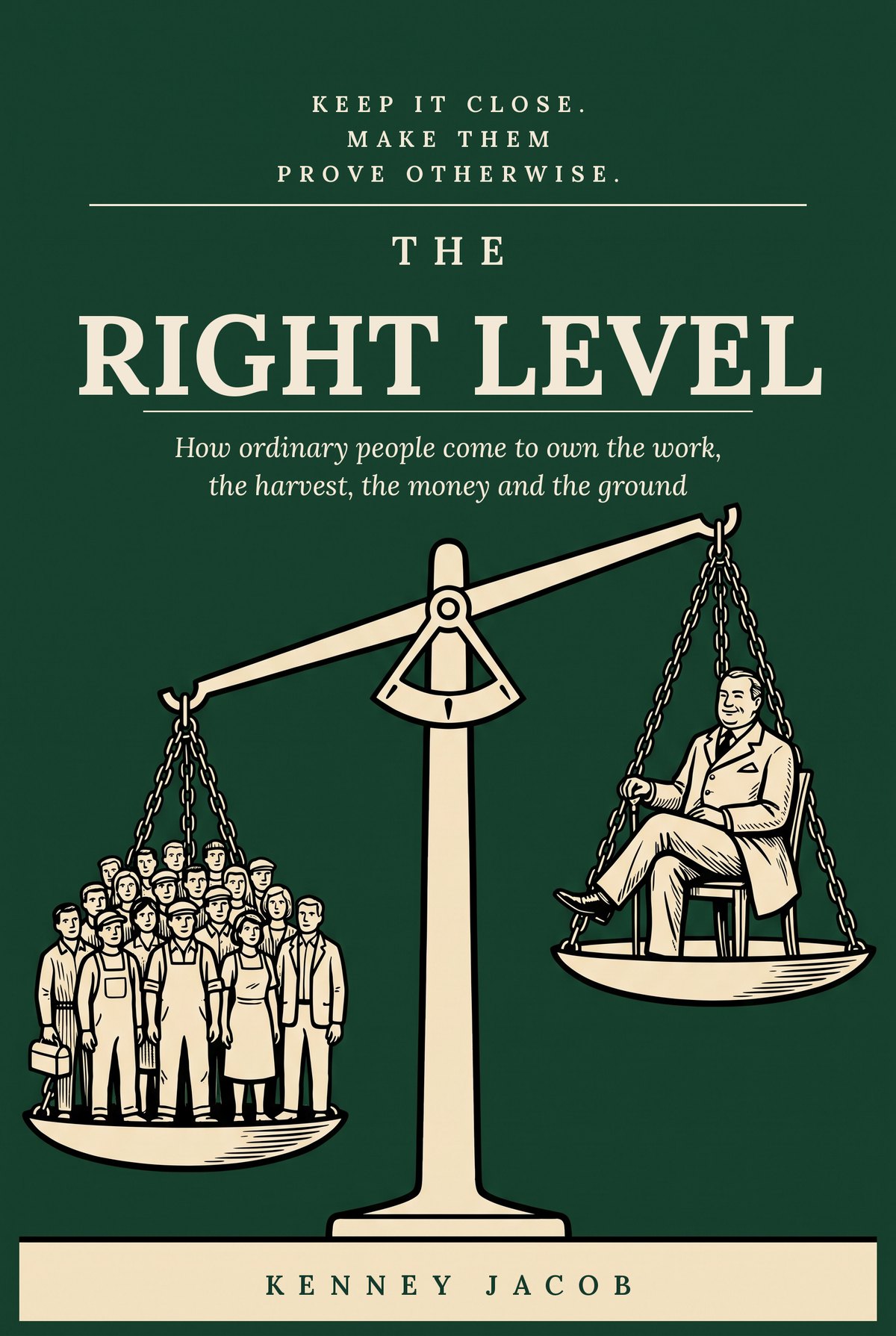
The Right Level
How ordinary people come to own the work, the harvest, the money and the ground.
0 readers have already pre-booked
No payment now — reserve your place, then just ₹499 at launch.
The knowledge was at the bottom. The decision was at the top.
Nineteen years of skill sat in the hands of the women who cracked the nuts. The duty was fixed in Delhi. The price was set in Abidjan. The owner ran the arithmetic in an office none of them had ever entered — and tied a notice to the gate.
Not one of them was in the room where the decision was taken.
We treat that gap as if it were weather — as though it simply arrived, and the only question was how to endure it. It is not weather. It is an arrangement. People built it, decision by decision. People can build it differently. Most of this book is about the ones who already have.
Power belongs at the smallest level that can actually carry it.
Push a decision — or the ownership of a thing — further up and further away, and the burden of proof is on you. It has a name most readers have never heard: subsidiarity. And here is the engine of the book: it is fought precisely because it works. When ordinary people own the bank, the land, the grid, the firm they work in, they hold the power that comes with it — and no one hands that over willingly.
The record of what has actually worked — and where it broke.
Owning the work
Worker cooperatives that held: Mondragón's wage cap, and a hundred years of roads in Malabar built by the men who walk them.
Owning the harvest
Amul, born fighting a monopoly; SEWA, when the producer is a woman the law forgot; and the strain that comes with scale.
Owning money
How neighbours lend when banks can't — and what happened where people sold the very thing that kept them safe.
Owning the ground
The forest the village kept, the tragedy that wasn't, and eight things to check before you trust a commons.
Owning the wires
Energy, water and the digital commons — the wind belongs to whoever puts up the mast.
Where small fails
Three chapters do only one job: the village as a cage, the cooperative that rots, the things that genuinely cannot be kept close.
It ends as a manual, not a mood.
The book closes with a builder's agenda, a field guide, and three rules drawn from a century of things that survived the pressure every successful redistribution of ownership eventually attracts.
Build independent
Not dependent on a patron who could withdraw the patronage — and so control you. Dealings with power are fine. Dependence on it is the danger.
Build small
At the smallest scale the task allows, where no one is a stranger to the decision — then nest the small units upward for the jobs that need scale.
Build revenue-bearing
It must earn its own keep. There is no greater threat to a thing's independence than insolvency.
Reserve The Right Level before it launches.
Add your name to the pre-book list and you'll be first in line the day it goes on sale — at the launch price of just ₹499, with a priority link sent straight to you. No payment now; just your details.
Your copy is reserved.
You're on the pre-book list — among the first we'll notify when The Right Level launches, with your priority link. Keep an eye on your inbox.