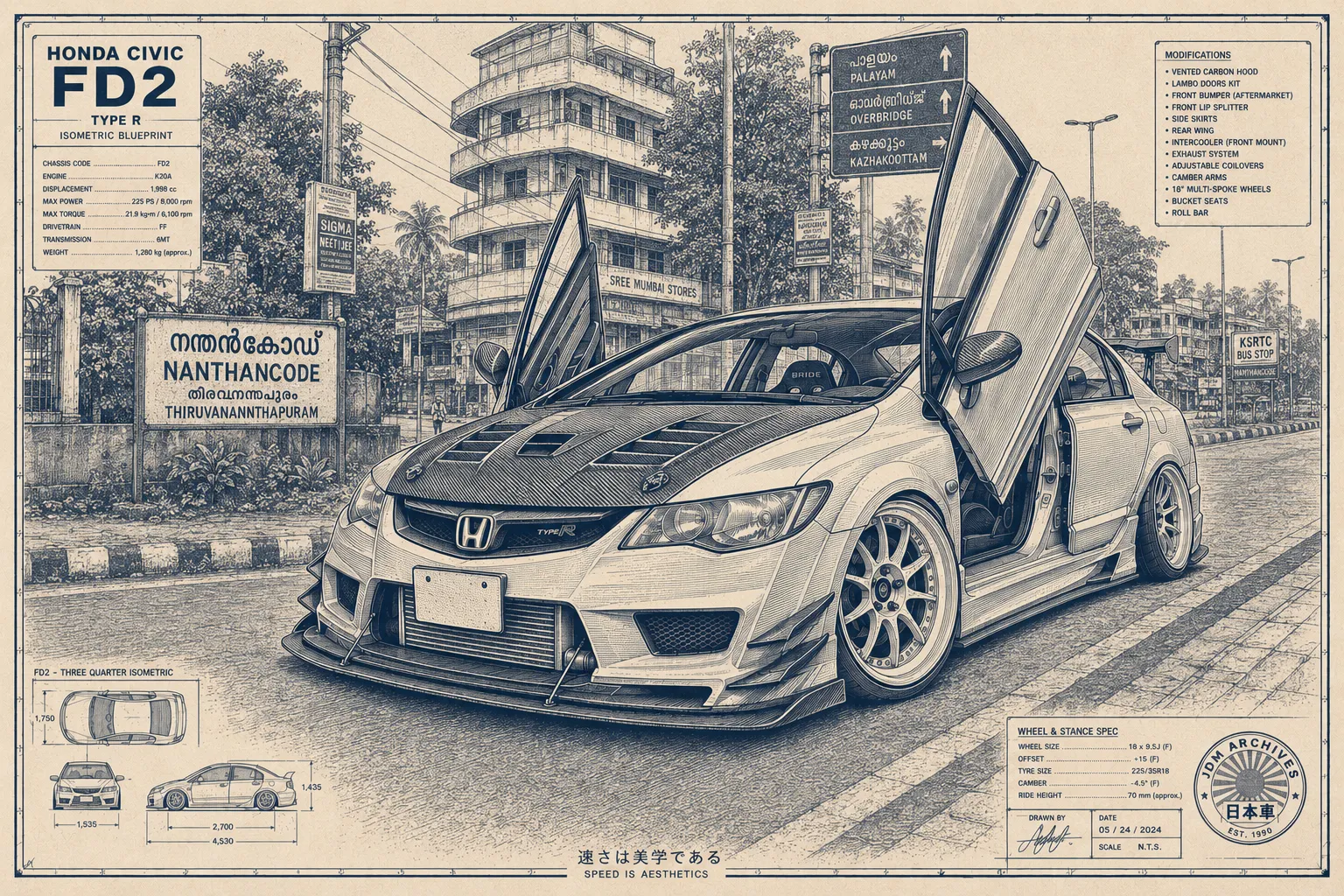
We need proper vehicle-modification regulations codified into law with Presidential assent — not the present limbo of uncertainty, conflicting interpretations, and arbitrary enforcement that leaves owners, restorers, and enthusiasts guessing. Most of what is currently being discussed is inadequate and ignores the practical realities of ownership, restoration, and automotive innovation. This brief sets out the constitutional path, the specific modifications that should be permitted, and a public vote on what people actually want.
Select every modification you want to see legalised, add your details, complete the verification, and cast your vote. Results update live so everyone can see what the community actually wants codified into law.
0people have voted so far
Yes.
The short answer
The verdict
Kerala can constitutionally permit vehicle modifications that conflict with Section 52 of the Motor Vehicles Act — but only through a State law passed under Article 254(2) and granted the President's assent.
Required
An Act of the Kerala Legislature — not a rule, circular, or executive order.
Reserved
The Bill must be reserved for the President's consideration before it takes effect.
Revocable
Parliament retains the power to later amend, vary, or repeal the State law.
The Supreme Court has interpreted the existing central law. It has not held that States are constitutionally forbidden from legislating differently on this Concurrent List subject — only that they have not, in fact, done so.
The argument, in three movements
The doorway is in the Concurrent List.
01
Competence
Both Parliament and Kerala can legislate on motor vehicles.
"Mechanically propelled vehicles" sit at Entry 35, List III of the Seventh Schedule — the Concurrent List. Parliament can legislate, the State can also legislate, and any clash is resolved through Article 254. The subject is not exclusively Union territory.
Parliament may legislate
States may legislate concurrently
Conflicts → Article 254
A shared field, not a forbidden one.
02
Barrier
Section 52, read strictly, is the wall.
Section 52 of the Motor Vehicles Act, 1988 bars alterations that change a vehicle's manufacturer specifications, save for limited Centre-approved retrofitments. The Supreme Court has, in recent decisions, read the provision strictly: alterations beyond the approved carve-outs are impermissible under the present central regime.
Statute: Parliament's MV Act, 1988
Doctrine: strict construction
Effect: rules & circulars cannot displace it
The Court read the statute. It did not seal the Constitution.
03
Escape
Article 254(2) is the constitutional key.
Where a State law on a Concurrent List subject is repugnant to an earlier Union law, it may still prevail within that State — if it has been reserved for the President's consideration and has received assent. This is the doorway Kerala must walk through, deliberately.
Draft a State amendment law
Identify the conflict with §52 expressly
Reserve the Bill for Presidential assent
Assent transforms repugnancy into permission.
What the law must permit
The modifications, codified.
The law should explicitly permit and regulate the following modifications, each subject to safety inspection, emissions compliance, and roadworthiness certification. The goal is a transparent, rule-based regime built on objective engineering standards — not the arbitrary discretion of individual officers.
Vehicle modification should be regulated, inspected, and certified — not effectively prohibited. The focus belongs on safety, emissions, and roadworthiness, not on preventing customisation altogether. Many developed automotive markets already permit these modifications under clear technical standards. India, and Kerala first, should adopt a similar framework.
Caveat I
Parliament retains the last word.
The proviso to Article 254(2) preserves Union supremacy. Parliament may, at any later date, enact a law "adding to, amending, varying or repealing" the State law that received assent.
Presidential assent is therefore powerful protection, not permanent immunity. Kerala's law lives at Parliament's tolerance — but it lives.
Caveat II
The path is used, but not on this subject.
States have invoked Article 254(2) for permit regulation, transport control, taxation structures, and regional transport variations — and received assent.
There is, however, no major reported Supreme Court case of a State expressly overriding §52's vehicle-modification restrictions. Kerala would be drawing the first map of this particular doorway.
The authorities
Cited & relied upon.
ConstitutionArticle 246 — Distribution of legislative powers
ConstitutionArticle 254(1) — Inconsistency between Union & State laws
ConstitutionArticle 254(2) — The Presidential-assent exception